
As recently as thirty-five years ago, athletic shoes consisted of just a few styles used for a wide variety of athletic events. There were a few tennis and basketball shoes, no shoes marketed specifically for walking, no aerobics or fitness shoes, and only a small number of running shoes.
Today, the number of brands and styles in athletic shoe stores is staggering. There are shoes made specifically for wrestling, rock climbing, and windsurfing, as well as for more common sports like running, basketball, tennis, racquetball, aerobic dance, and walking. In the running shoe market alone, nine major manufacturers each offer five to ten models within their line.
This increased selection raises the chance of finding the right shoe for any foot — but it also creates confusion for the consumer. The diversity and complexity within athletic shoes are actually their most interesting aspect. Shoes with different shapes, materials, and construction methods all function differently on the foot.
The purpose of this article is to explain the major structural differences between the three broadest categories of athletic shoes — running shoes, court shoes, and fitness shoes — so that their functional differences can be better appreciated.
Running Shoes
The Biomechanics of Running
Running, like walking, is considered a straight-ahead sport since it involves no sudden stops, turns, or other maneuvers. Most runners land on their heels and then propel off their toes, repeating this heel-to-toe cycle thousands of times every session.
There are two major biomechanical differences between running and walking:
- In running, there is always a moment when both feet are off the ground.
- The impact forces the foot absorbs during running are at least twice as great as those in walking.
Pronation and Supination
Most runners strike on the outside of the heel, rapidly pronate, stay pronated briefly, and then resupinate as the heel leaves the ground during push-off.
Pronation is a rolling inward of the ankle in which the arch flattens. Supination is a rolling outward of the ankle in which the arch increases in height.
Many runners pronate excessively, which can lead to a range of running injuries, including posterior tibial tendinitis, plantar fasciitis, and pes anserinus bursitis.
The Cushion-Versus-Control Tradeoff
Because of the increased impact forces and excessive pronation seen in running, running shoes must be designed to reduce shock and help control pronation.
Unfortunately, the same design characteristics that best control pronation also tend to reduce cushioning. Conversely, any shoe designed to maximize cushioning will tend to have decreased ability to control pronation.
Structural Components: Sole and Upper
Every shoe is made of two basic parts: the sole and the upper.
- The sole protects the foot from the ground and provides cushion.
- The upper covers the top and sides of the foot to provide a comfortable fit and improve stability on the sole.
The Outersole
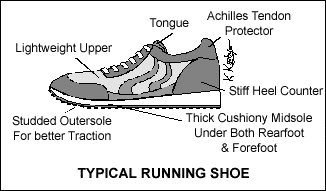
In a running shoe, the sole has two distinct layers: the outer sole and the midsole. The outer sole is the part that contacts the ground. It is made of a thin layer of hard, abrasion-resistant material that resists wear, provides traction, and allows forefoot flexibility for propulsion.
Many running shoes use a high-carbon rubber compound in the heel and forefoot — similar to an automobile tire — so the outsole resists abrasion from heel strikes. Outsoles also use studs or ridges in the midfoot and forefoot for traction on soft or slippery surfaces such as wet grass or slick pavement. Transverse grooves in the forefoot make the shoe more flexible during push-off.
The Midsole
The midsole is the part of the running shoe that determines whether it works well or poorly. Sandwiched between the upper and the outer sole, the midsole’s design largely determines whether the shoe will be good for cushioning, good for controlling pronation, good for heavy runners, or good for nothing.
Running shoe midsoles are designed with thick cushioning under both the heel and forefoot. The total height of the midsole and outer sole is generally about 1 inch under the heel and about 5/8″ under the forefoot. Most runners prefer the 3/8″ difference, which reduces strain on the Achilles tendon and lowers the likelihood of Achilles tendinitis.
Midsole Materials
The two most common midsole materials are:
- EVA (ethyl vinyl acetate) — a copolymer of ethylene and vinyl acetate with microscopic air bubbles. Lightweight and very cushiony.
- PU (polyurethane) — also has a microscopic air bubble structure, but is generally firmer and more resistant to compression than EVA.
Manufacturers combine different densities of EVA and/or PU within the midsole, along with gel packets, air bags, plastic plates, and other exotic materials to provide the right balance of cushioning and pronation control.
Many midsoles use a firmer material or a hard plate under the medial (big toe) side of the heel and a softer material under the lateral (little toe) side. This dynamic varus wedge effect helps control pronation. The softest midsole material is generally placed under the forefoot, since most runners prefer good forefoot cushioning on hard surfaces.
The Upper
The upper of a running shoe is usually made of lightweight nylon combined with thin synthetic or natural leather to reduce overall weight. Because running involves at least a thousand foot strikes per mile, a lightweight shoe is critical for moving faster with less fatigue.
One drawback to lightweight materials is reduced side-to-side stability — thin upper materials are less effective at resisting medial and lateral shifting of the foot on the sole.
Running shoe uppers also feature:
- A stiff heel counter, typically stiffer than in other athletic shoes, to help control excessive pronation or supination.
- A raised, padded “Achilles tendon protector,” which most runners find serves mainly as a convenient handle for pulling the shoe on, rather than offering real Achilles protection.
Sockliners
Inside today’s running shoes are removable insoles known as sockliners. They cushion the foot and provide some arch support. More expensive shoes typically have sockliners that better support the arch than cheaper ones. Nearly all sockliners can be easily removed, allowing custom foot orthotics to be added if needed.
Running Shoes as Walking Shoes
Running shoes make excellent walking shoes. Since running and walking are both straight-ahead activities, their shoe designs are quite similar.
In fact, I recommend running shoes for patients who walk for exercise over many walking shoes — running shoes are lighter, more comfortable, and biomechanically more efficient at controlling excessive pronation than most walking shoes.
Court Shoes
Demands of Court Sports
Court sports include tennis, racquetball, basketball, squash, badminton, and volleyball. Because these sports require sudden starts, stops, and side-to-side motion, the best construction for court shoes differs markedly from that of running shoes.
For example, if a tennis player moves quickly to the right and then plants the right foot to stop, the foot tends to slide laterally on top of the sole. The only thing keeping the foot from sliding off the sole is the upper. Side-to-side stability is everything.
Upper Heights: Low, Mid, and High Cut
Unlike running shoes, where the upper always ends just below the ankle bones (a low-cut shoe), court shoes come in three heights:
- Low-cut — ends below the ankle bones.
- Mid-cut — extends partially over the ankle bones to about the ankle joint level.
- High-cut (high-top) — extends above the ankle bones, completely covering them.
Many basketball shoes are higher cut because of the frequency of ankle sprains in basketball. All else being equal, the higher the cut, the better the shoe is at preventing ankle instability — and the heavier it will be.
Construction and Materials
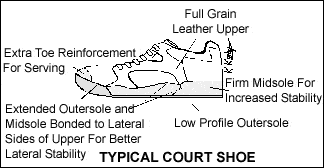
Because the upper must hold the foot on top of the sole, court shoe uppers are thicker and heavier than those of running or fitness shoes. They use thicker leathers or synthetic leathers, and lightweight materials like nylon are used less frequently.
Many tennis shoes add an extra layer of synthetic or natural leather to reinforce the toe box and prevent wear from scuffing during serves.
Many court shoes also feature an extended outer sole or midsole that rises the sides of the upper, strengthening the sole-to-upper junction. The combination of thicker materials and extended sides makes court shoes nearly always heavier than running shoes of the same size.
Outersole Design
Court shoe outer soles are usually made of a non-marking rubber compound for traction on indoor or outdoor courts. The tread profile is much lower than on running shoes, since court sports are nearly always played on dry, flat, smooth surfaces.
Court shoes often feature circular designs under the forefoot that serve as a “pivot point” for rotational foot motion on the playing surface.
Midsole Stability
Court shoe midsoles, like running shoe midsoles, are predominantly EVA or PU — but they are firmer and thinner. This reduces instability during side-to-side movements.
Firmer soles offer better lateral stability because body weight doesn’t deform them as easily. The more a sole deforms, the more it tilts, which can lead to instability at the ankle due to pronation or supination.
Thinner soles also help prevent ankle sprains. The higher the ankle is off the ground, the longer the lever arm for ground reaction forces to twist the ankle. Keeping the foot lower reduces this lever arm and the risk of injury.
Fitness Shoes
A New Category Emerges
About fifteen to twenty years ago, aerobic dance surged in popularity. At first, aerobic dancers wore either running or court shoes — neither of which was designed for the demands of the activity, leading to many injuries.
- Dancers in running shoes had good forefoot cushion but suffered ankle sprains due to poor lateral stability.
- Dancers in court shoes had good side-to-side stability but experienced forefoot pain due to insufficient forefoot cushioning.
The Aerobics Shoe Solution
Shoe manufacturers responded by blending technologies from running and court shoes. The result was a midsole thickness and cushioning level midway between the two, and an upper midway between the two in material weight and thickness.
Today, shoes made for aerobic dance are very similar in design to those for various health club activities, so they are now collectively known as fitness shoes. Their relatively recent emergence demonstrates how shoe manufacturers can design a completely new shoe style to meet the biomechanical demands of a new sport.
An All-Purpose Hybrid
Fitness shoes use technological features from both running and court shoes to create what is arguably a better all-purpose shoe than either. They are:
- Lighter and better cushioned than court shoes.
- More resistant to side-to-side movement than running shoes.
The Upper
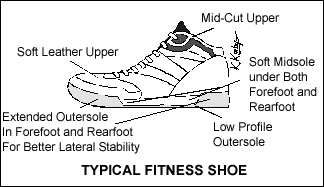
Fitness shoe uppers range from low-cut to high-cut, with mid-cut being the most popular. Mid-cut uppers provide extra lateral stability without significantly increasing weight.
The upper combines thinner natural or synthetic leather with nylon, reducing weight compared to a court shoe. Yet because the upper is more substantial than that of a running shoe, lateral stability is better.
Like court shoes, many fitness shoes use an extended outer sole or midsole on the medial and lateral sides to strengthen the sole-to-upper junction and add lateral stability.
Sole Construction
The outer sole is very similar to a court shoe’s — non-marking rubber in a low profile. However, the midsole is thicker than that of a court shoe to provide extra cushioning in the forefoot and rearfoot during aerobic dance, running, and other impact activities.
While not as thick as a running shoe midsole, a fitness shoe midsole can safely be thicker than a court shoe midsole because the side-to-side activities in fitness sports are less aggressive than those in court sports.
Conclusion
In every case, the shoe’s structure determines how it affects the foot’s function inside it.
Whether it is the composition of the outer sole, midsole, or upper, how the sole is attached to the upper, or any other design parameter, the construction of an athletic shoe must match the biomechanical requirements of its specific activity to be useful and desirable for the athlete.
If you need help choosing an appropriate athletic shoe, contact Sweeney Foot & Ankle Specialists.